The Mythos Lesson: Why Your Cloud Must Defend Itself
Claude Mythos proved that every organization should assume vulnerabilities will be found and breaches can happen. But the attack chain only starts there. The real cloud security test is how far your environment lets an attacker go. As AI accelerates attack-path discovery, the answer is not faster response alone. It is a hardened, secure-by-design cloud architecture that blocks the attacker’s next move before it succeeds.
A containerized API is exposed to the internet. An attacker finds a zero-day and gets remote code execution on the workload.
But RCE is not the full story. In cloud environments, the real question is what that workload can reach next.
Can it reach credential sources? Can it obtain workload identity credentials? Can those credentials be used outside the trusted environment? What control-plane and data-plane APIs can they call? Can they access sensitive data? Can they move laterally across accounts, subscriptions, projects, or tenants? Can they create persistence, weaken visibility, or trigger destructive actions?
The vulnerability was the entry point. The cloud architecture determined the blast radius.
The Attack Timeline Just Compressed
On April 7, 2026, Anthropic published a technical assessment of Claude Mythos Preview, a model capable of autonomously identifying and exploiting zero-day vulnerabilities across every major operating system and every major web browser.
During testing, Anthropic says Mythos identified and exploited zero-day vulnerabilities across every major operating system and every major web browser. Anthropic also says Project Glasswing has identified thousands of zero-day vulnerabilities across critical infrastructure, many of them critical, including a now-patched 27-year-old bug in OpenBSD and a 16-year-old remote-code-execution vulnerability in FFmpeg.
Mythos is a vulnerability-finding breakthrough, but it is important to be precise about what it demonstrated. Anthropic showed Mythos finding and exploiting software vulnerabilities – memory corruption, code execution, authentication bypasses. It was not demonstrated chaining cloud control-plane attacks, harvesting cloud credentials, or performing lateral movement through IAM.
The real concern is what happens when an attacker combines Mythos-class vulnerability discovery with existing cloud exploitation tooling – cloud-aware agents, credential harvesters, enumeration frameworks. The zero-day may be the hardest new ingredient; many of the post-exploitation steps already have mature tooling.
The Real Risk Is What the Cloud Allows Next
Cloud compromise is rarely about one issue in isolation. A vulnerable application becomes dangerous when it connects to an over-permissioned workload identity. That identity becomes more dangerous when its credentials can be used from untrusted networks. Those credentials become more dangerous when resource policies trust them too broadly. And the entire chain becomes critical when the organization allows identity changes, logging changes, lateral movement, or destructive control-plane actions.
That is the architectural lesson. AI can accelerate the process of connecting these pieces into one executable path. Traditional cloud security usually sees them as separate findings: a vulnerability here, a misconfiguration there, an identity risk somewhere else, a resource exposure, a visibility gap, a missing guardrail. But an attacker does not care which team or tool owns each finding. They only care whether the next step is reachable.
Traditional Defense Was Not Built for Autonomous Attack Pace
Most cloud security programs are still built around a reactive sequence: find the issue, open a ticket, assign ownership, remediate, and monitor for abuse. That model assumes there is enough time between discovery and impact for humans, tools, and teams to catch up.
AI-assisted attackers compress that window. When the gap between zero-day discovery, exploit validation, workload compromise, credential harvesting, permission enumeration, and the final malicious operation collapses to machine speed, reactive defense becomes structurally mismatched. The attacker is not waiting for vulnerability management, posture management, identity governance, detection engineering, and platform teams to coordinate. They are chaining each reachable step into the next operation.
Adding AI to the defense stack helps, but it does not fix the model. Autonomous remediation can rotate credentials, revoke policies, isolate workloads, or close findings faster. But it still runs after something was detected, after a risk was identified, or after the cloud already accepted the action.
That sequence matters. Rotating stolen credentials does not undo API calls already made. Revoking access does not retrieve copied data. Disabling a compromised path does not remove persistence already created. Restoring logging does not recover the blind window. Blocking deletion after the fact does not bring back destroyed resources.
This is the weakness of simply making reactive defense faster. Cloud environments are API-driven, and API-driven damage can happen in a single accepted call. The strategy has to shift from faster cleanup to pre-execution denial: preventing the most dangerous next actions from being accepted in the first place.
The Same Attack Path, Blocked by Preventive Guardrails
Go back to the containerized API. The attacker finds a zero-day and gets RCE. Without preventive guardrails, that single exploit can become the start of a full cloud attack path. But with preventive guardrails, the chain starts breaking early.
Credential harvesting from workload environments. If the attacker tries to obtain credentials through metadata services, managed identity endpoints, projected tokens, mounted secrets, environment variables, or workload identity mechanisms, access to those credential sources should be hardened and minimized. Workloads should receive only the identity they need, credential sources should not be reachable from untrusted code paths, and long-lived credentials should be eliminated wherever possible.
Credential use from untrusted locations. If credentials are obtained another way, network and identity conditions should reduce where those credentials are useful. Sensitive control-plane and data-plane operations should be accepted only from expected environments where the cloud provider and service support those restrictions. This usually requires combining private connectivity, source conditions, resource policies, organization-level policies, conditional access, and identity-aware controls – not relying on credentials alone.
Lateral movement into data or adjacent environments. If the attacker tries to pivot into sensitive data or neighboring environments, organization-scoped policies should restrict which identities can access which resources, bounded to the organization perimeter. The goal is to prevent a compromised workload identity from becoming a bridge into another account, subscription, project, tenant, cluster, or data boundary.
Privilege escalation through identity manipulation. If the attacker tries to abuse identity systems for privilege escalation, higher-level guardrails should block risky identity actions: attaching broad permissions, changing trust relationships, creating long-lived keys, assigning privileged roles, modifying service principals, or passing privileged identities to compute services. These controls should apply even when an individual compromised identity appears to have permission locally.
Persistence and visibility disruption. If the attacker tries to create a shadow identity, weaken audit trails, disable monitoring, remove log exports, alter retention, or detach an environment from centralized governance, preventive guardrails should block those actions at the policy layer. Visibility controls should be treated as protected infrastructure, not optional settings owned by each workload team.
Destructive control-plane actions. If the attacker tries to delete data, destroy infrastructure, disable recovery mechanisms, or alter backup and retention controls, policy should require stronger conditions than ordinary workload access. Destructive actions should be isolated behind break-glass paths, approval workflows, recovery protections, or organization-level deny rules wherever possible.
Each guardrail does not need to stop the attacker completely. Together, they systematically eliminate the most dangerous next moves at every stage of the chain.
These guardrails should be rolled out like production controls, not like one-time findings. Start in audit or report-only mode where available, test in a canary environment, document exceptions, define break-glass paths, and monitor for workload impact before broad enforcement. The goal is not to block every possible action on day one. The goal is to make the highest-impact attacker moves impossible by default, while preserving safe operational paths for engineering teams.
What This Looks Like in Practice
In practice, preventive guardrails look different across providers, but the pattern is the same.
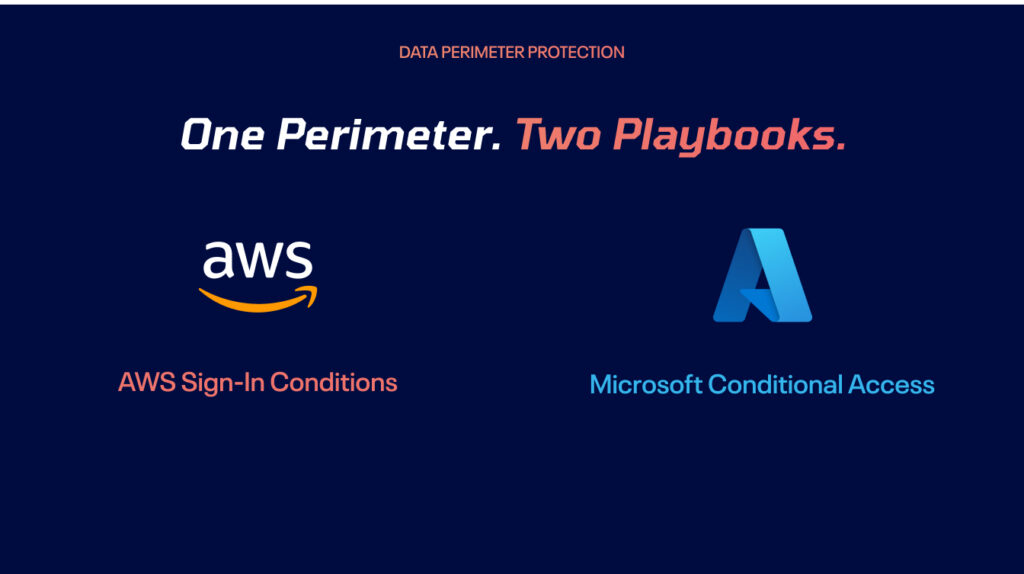
In AWS, this may mean enforcing IMDSv2, minimizing metadata access from containers, using workload-specific roles, restricting sensitive API calls through VPC endpoints and policy conditions, applying SCPs or RCPs at the organization level, protecting CloudTrail and log destinations, and denying high-risk IAM actions except through approved break-glass paths.
In Azure, it may mean using managed identities with least privilege, Private Link and service firewalls for supported data-plane services, RBAC and PIM for privileged access, Conditional Access for management-plane access, management-group policies for configuration guardrails, and protections around diagnostic settings, log export, and retention.
In GCP, it may mean service account least privilege, disabling unnecessary service-account keys, IAM Deny, organization policy constraints, VPC Service Controls for sensitive data boundaries, private access patterns where supported, and centralized audit-log sinks protected from workload-level modification.
The point is not that one provider feature solves the problem. The point is to make the dangerous next move fail at the policy layer, even when a workload is compromised.
This Is What a Self-Defending Cloud Means
A self-defending cloud is not a cloud that detects and responds to attacks. It is a cloud where the most dangerous control-plane and data-plane actions are denied by architectural policy, regardless of what any individual identity is technically allowed to do.
Not a cloud without vulnerabilities. A cloud where the most dangerous next moves are denied by design.
The Mythos Lesson
Mythos should not be understood only as a vulnerability-finding milestone. It is a signal that the pace of attack-path discovery is changing. AI can make it easier to find unknown vulnerabilities, validate exploitability, and combine those capabilities with tooling, credentials, and cloud APIs to chain the next steps from initial access to real cloud impact.
That means cloud security strategy has to change. The question is no longer only: can we detect the attacker fast enough? The better question is: can the cloud block the attacker’s next move by design?
Because in the AI era, the winning strategy is not only faster response. It is reducing what attackers are allowed to do after the first compromise.
Close the doors before an AI-driven attacker tries to open them.
FAQ
1. What is Claude Mythos?
Claude Mythos is Anthropic’s AI model capable of autonomously identifying and exploiting zero-day vulnerabilities across every major operating system and web browser. During testing in April 2026, it discovered over 2,000 high- and critical-severity vulnerabilities, including a 27-year-old OpenSSL bug and a 16-year-old FFmpeg flaw. Anthropic gave early access to a consortium of security partners through Project Glenning, backed by $100M in usage credits.
2. Why can’t traditional cloud security stop AI-assisted attackers?
Traditional security tools handle threats in silos: SIEM manages misconfiguration, IAM handles identity risk, cloud teams handle network and policy issues. An AI attacker combines all of these attack paths into a single, fast, executable chain. Traditional defense was designed for slow, human-coordinated attacks – not machine-speed lateral movement across cloud services.
3. What is a self-defending cloud?
A self-defending cloud is one where the most dangerous control-plane actions are denied by architectural policy, regardless of what any individual identity is technically allowed to do. It is not a cloud without vulnerabilities – it is a cloud where the most dangerous next moves are denied by design.
4. Why is autonomous AI remediation not enough against AI-assisted attackers?
Autonomous remediation is reactive. Cloud damage can happen in a single API call. If credentials were stolen before remediation triggered, revoking them does not undo the API calls already made. If data was already exfiltrated, revoking external access does not retrieve it. If a shadow identity was created, the persistence already exists before logging triggers. AI can accelerate investigation but cannot undo actions the cloud already allowed.
For more guidance on designing cloud environments that enforce security against AI agents and AI-driven threats, visit the Blast blog.