Why Cloud Security Visibility Isn’t Enough (The Prevention Gap)
As cloud change accelerates and agent-driven actions reshape risk, visibility alone is no longer enough. Complementing the visibility-based operating model with prevention is the next must-have step for security teams that need to stop critical risks from materializing in the first place.

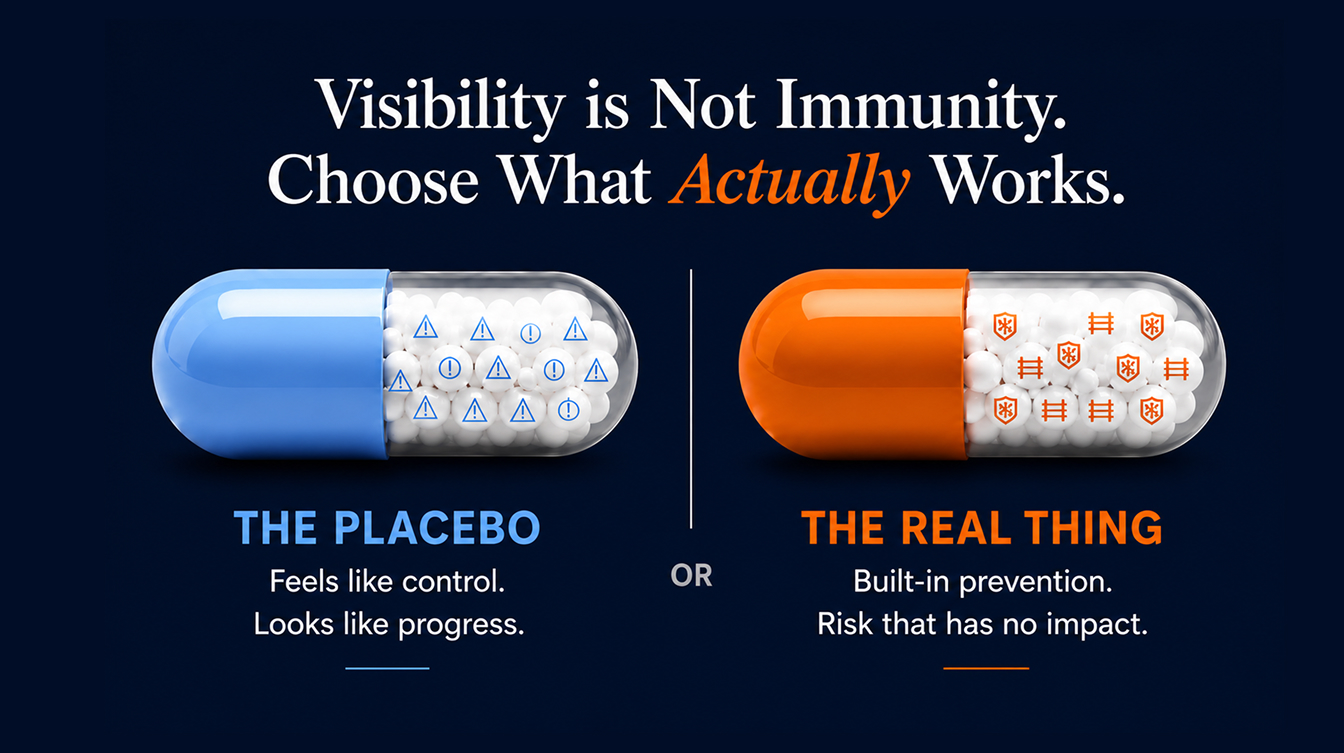
When awareness feels like control
One of the most interesting things about the placebo effect is not that people are “fooled.”
It’s that perception can create a very real experience.
The same dynamic exists in cybersecurity.
For the past decade, visibility has been the foundation of cloud security. And rightfully so.
You cannot secure what you cannot see.
The ability to continuously map assets, detect misconfigurations, prioritize risk, and understand exposure transformed how security teams operate.
Visibility gave organizations something they desperately needed in complex cloud environments:
- Asset awareness
- Risk discovery
- Exposure management
- Prioritization
- Operational focus
It became the foundation of modern cloud security.
But it also introduced an unintended side effect.
Visibility can create the feeling of control, even when the environment itself has not changed.
The gap between knowing and controlling
A complete inventory feels like control.
A prioritized list feels like progress.
A remediation workflow feels like risk reduction.
And in many cases, it is.
But there is a critical difference between knowing something exists and changing what is possible.
An attacker does not see your risk score.
They don’t care that an exposure was:
✓ Discovered
✓ Categorized
✓ Prioritized
✓ Assigned
✓ Added to a remediation queue
They care about one thing:
Is the path still available?
Can the permission still be used?
Can the configuration still change?
Can the action still execute?
More visibility. More context. Same exposure.
This is the gap many mature security organizations are now confronting.
They have more than ever before:
- More visibility
- More alerts
- More context
- Better prioritization
Yet the operating model is often still based on discovering risk after it exists and racing to remove it before it matters.
That approach made sense when cloud moved at human speed.
But cloud no longer does.
Infrastructure changes continuously.
Permissions expand dynamically.
AI agents introduce a new class of machine-driven actions where waiting for detection, prioritization, and remediation becomes increasingly difficult.
Visibility is not the opposite of prevention
The next evolution of cloud security is not replacing visibility.
It is completing it.
Think about the difference:
Visibility asks:
“What is happening in my environment?”
Prevention asks:
“What should never be allowed to happen in my environment?”
One gives awareness.
The other changes outcomes.
From seeing risk to eliminating paths
The most resilient cloud environments will not only be the ones that identify risk faster.
They will be the ones designed so the most critical risks cannot materialize in the first place.
Because knowing about a problem is powerful.
Making sure it cannot happen is something else entirely.